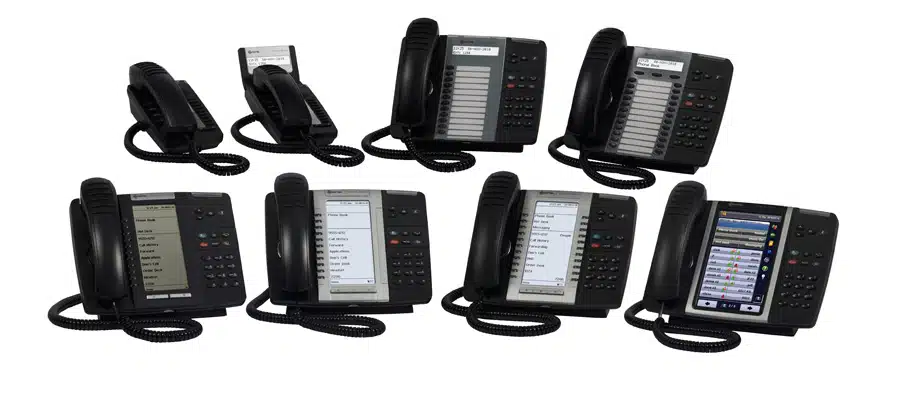
Mitel is actively operating but filed Chapter 11 bankruptcy in March 2025 — and several of its most widely installed systems are now past their end-of-life dates
Mitel Networks filed Chapter 11 bankruptcy on March 10, 2025 with $1.15 billion in debt, after a failed cloud partnership with RingCentral and a leveraged acquisition strategy that left the company unable to refinance its debt. Mitel emerged from Chapter 11 bankruptcy in June 2025 under a new ownership group of former lenders. However, its two most widely installed on-premises systems — MiVoice Connect (ShoreTel) and MiVoice Office 250 — are either past or approaching full end-of-life dates. If your business runs either of these platforms, migration is not optional. It is a matter of timing.
Mitel Bankruptcy & End of Life: What It Means for Your Phone System
Mitel has been one of the most acquired, merged, and restructured companies in the business communications industry — absorbing Inter-Tel, Aastra, ShoreTel, and Unify over a decade of deal-making. The result is a product portfolio with dramatically different statuses: some platforms are actively end-of-life, others are still being sold and developed, and all of them exist inside a company that went through Chapter 11 bankruptcy in 2025, emerging that June under new ownership.
Understanding which Mitel system you’re on — and what that system’s specific timeline looks like — is the first step to making a smart migration decision. Phonewire can replace any Mitel system with a fully managed modern alternative: professional installation, your numbers preserved, staff trained on day one, and U.S.-based support that picks up in under a minute.
What Usually Brings People to This Page
Almost nobody replaces a working Mitel system on a whim. Three things bring people here: MiVoice Connect stopped receiving security patches at the end of 2025 and Office 250 support ended in June 2026; a controller failed; or a carrier rep offered cheaper lines to keep the old switch alive. If one of those is you, the answer is the same: keep the phones and wiring that still work, replace what is failing, and do it on a planned date instead of an emergency one.
How many phones are on your Mitel system? Tell us the count and the building, and we come back with an itemized quote, not a range. Request a quote or call (800) 857-1517 — a real person answers.
Your Mitel Platform — And What Its Status Actually Means
What Happened to Mitel — A Brief Timeline
What Mitel’s bankruptcy means practically for on-premises customers
Mitel’s restructuring plan was approved and the company continues to operate. Channel partners were told they’d be paid in full. For customers on MiVoice Business (MiVB) specifically, day-to-day operations continue as before. The practical concern is not immediate discontinuation — it’s the context in which you’re evaluating a long-term infrastructure commitment. A company eliminating $135 million in annual interest payments is not simultaneously making aggressive investments in legacy product support, engineering, or customer experience. For businesses on MiVoice Connect or MiVoice 250, the EOL timelines are independent of the bankruptcy and were set before it. Those deadlines stand regardless of what happens to Mitel’s capital structure.
What Phonewire Recommends for Mitel Migrations
Phonewire Hybrid System
For businesses moving off MiVoice Connect or Office 250 who want on-premises reliability, flat licensing, and a single managed support relationship — Phonewire is the direct path forward.
- On-premises appliance — hardware at your location
- One-time hardware, then a flat annual licence
- SIP trunks sized to your actual call volume
- Snom, Yealink, Poly, or Panasonic desk phones
- Optional cellular failover add-on
- Full on-site installation + same-day staff training
- U.S.-based support answered in under 1 minute
- Day-to-day changes at no additional charge
- No per-seat licensing complexity
Phonewire Cloud-Hosted
MiVoice Connect was cloud-hosted in architecture — many businesses on it value the flexibility of no on-premises hardware. Phonewire’s cloud-hosted option delivers the same flexibility with fully managed support and no per-user complexity.
- Predictable per-user monthly pricing — no hardware purchase
- Works across any number of locations
- Same Linkus UC mobile and desktop apps
- Voicemail to email, auto-attendant, call recording
- Microsoft 365 integration
- Same U.S.-based support and change service
Systems scale from a handful of extensions to enterprise deployments — see how our pricing works, or tell us your extension count and we’ll scope it properly.
Frequently Asked Questions
My system is MiVoice Connect. Is it still safe to run in 2026?
Not from a security standpoint. As of December 31, 2025, MiVoice Connect stopped receiving operating system updates, patches, and security fixes. Running an unpatched, unsupported phone system in 2026 creates real cybersecurity risk — particularly for businesses subject to HIPAA, PCI, or other compliance frameworks (MiVoice Connect specifically lost HIPAA compliance support in October 2024). The system will continue to place calls, but it cannot be expanded, it won’t receive security updates, and it becomes increasingly fragile over time. Migration planning should be in progress now if it isn’t already.
Does Mitel’s Chapter 11 bankruptcy mean the company is going away?
Not necessarily. Mitel filed Chapter 11 — a restructuring, not a liquidation. The company continues to operate, partners are being paid, and MiVoice Business is still being sold. The restructuring reduces Mitel’s debt by $1.15 billion and reduces annual interest expenses by approximately $135 million. Whether Mitel emerges as a stronger company or continues to struggle depends on factors that aren’t yet determined. For businesses on MiVoice Connect or MiVoice 250, the EOL timelines don’t change based on the bankruptcy outcome — those deadlines were set independently and stand.
I’m on MiVoice Business (MiVB). Do I need to migrate?
Not urgently. MiVoice Business has no published end-of-life date and is Mitel’s stated go-forward platform with active development. If MiVB is working for your business and your Mitel partner relationship is healthy, there’s no immediate technical reason to leave. The honest caveat is that MiVB is sold by a company in Chapter 11 bankruptcy, which is a reasonable factor to weigh when making a long-term infrastructure commitment. Phonewire can give you a total-cost-of-ownership comparison if you want to evaluate alternatives — but we won’t manufacture urgency that isn’t there.
Can I keep my existing Mitel phones on a new system?
Some Mitel phones can potentially be reused if they’re SIP-compatible models (5300 series and later IP phones). Older Mitel digital handsets (Superset series, 85xx series) use proprietary Mitel digital protocols and are not SIP-compatible. Phonewire evaluates your existing handsets during the pre-installation network assessment — if reuse is practical and cost-effective, we’ll tell you. Otherwise, new desk phones from Snom, Yealink, Poly, or Panasonic are provided as part of installation.
Can I keep my existing phone numbers?
Yes. Your business phone numbers port to the Phonewire system from wherever they’re currently hosted — SIP trunks, POTS lines, or any carrier. Porting typically takes 2–4 weeks. During the transition, your Mitel system remains live and call forwarding keeps all calls connected with no service gap.
What about the ShoreTel system I had before it became Mitel?
ShoreTel was acquired by Mitel in 2017 and rebranded as MiVoice Connect. The EOL timeline for MiVoice Connect applies to ShoreTel systems as well — the hardware and software are the same platform regardless of which nameplate is on the cabinet. If you’re running “ShoreTel” you’re running MiVoice Connect, and the December 2025 security patch cutoff applies to your system.
What Our Clients Say
Phonewire is a big asset for any company looking for professional advice and magnificent hands-on experts. Matt is efficient, reliable, and very detail-oriented. I am extremely satisfied with his cooperation and dedication.

Matt and his staff did a wonderful job on the install. They were very prompt, courteous, and very knowledgeable. We wouldn’t go anywhere else.

Free Mitel Migration Assessment
Tell us which Mitel platform you’re running — MiVoice Connect, Office 250, MiVoice Business, or a legacy system — how many users, and what’s driving your evaluation. We’ll give you a straight assessment of your timeline and a specific recommendation with pricing. Same day, no obligation.
One thing that makes the quote accurate: put the number of phones on your Mitel system in the message box below.
📞 Questions about Mitel’s EOL or migration options? We answer in under 1 minute.
(800) 857-1517