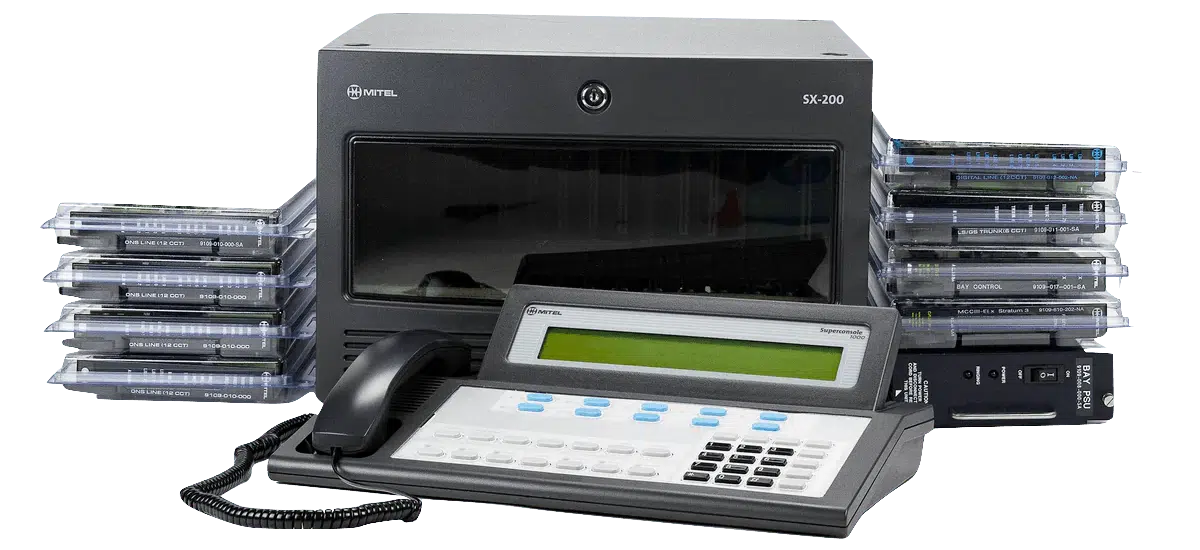
Replace Your End of Life Mitel Hotel Phone System — Hospitality Edition
If your hotel or motel runs a Mitel phone system — SX-200, SX-2000, MiVoice Connect, or MiCloud Connect — the window to plan a smooth replacement has already closed for one milestone and is closing for the rest. As of December 31, 2025, Mitel issued its last security patch and OS update for MiVoice Connect. The system still runs, but it no longer receives fixes. And in March 2025, Mitel filed Chapter 11 bankruptcy with $1.15 billion in debt. The company continues to operate under restructuring — but for hotel owners depending on Mitel for guest room phones, wake-up calls, and emergency communication, the practical message is the same: it’s time to move.
Phonewire installs hotel phone systems on-site nationwide — guest-room phones reused, PMS integration, E911 by room and floor.
What the Mitel EOL Timeline Means Right Now
The full MiVoice Connect end-of-life schedule is worth understanding before planning a replacement:
July 2024: New system sales ended — no new MiVoice Connect installations.
December 2024: Add-on sales ended — no hardware or software expansions to existing systems.
December 31, 2025: End of design support — no more OS updates, patches, or security fixes. Systems running past this date are unpatched indefinitely.
December 31, 2028: Hardware RMA ends — Mitel will no longer repair or replace failed hardware.
December 31, 2029: All support ends.
Phonewire’s Hospitality Edition cloud-based system is designed specifically for hotels and motels making this transition. It integrates with your existing analog room phones and wiring, eliminates PRI line costs, and includes the hospitality-specific features your guests expect — without a full property rewire or room phone replacement. Here’s what that looks like in practice. For the broader landscape beyond Mitel, see our guide to phone systems for hotels and hospitality.
Keep Your Existing Analog Room Phones
Mitel hospitality systems like the SX-200 and SX-2000 were designed around analog room phones — basic handsets wired directly through the property. Most hotels have hundreds of dollars per room invested in that infrastructure. Phonewire’s system integrates those existing analog handsets into a modern cloud-hosted platform using analog telephone adapters, so you keep the phones already in every room and still get full cloud PBX features at the front desk and back office.
The alternative — ripping out all room phones and running new CAT6 to every room for IP handsets — can add $500 to $1,500 per room in rewiring costs on a mid-size property. Phonewire’s approach avoids that entirely for the guest room portion of the install.
Eliminate PRI Lines and Reduce Monthly Phone Costs
Most properties running Mitel SX-200 or SX-2000 systems are still paying for PRI circuits — dedicated T1 lines that can run $400 to $800 per month or more depending on channel count and provider. Phonewire’s cloud system routes calls over your existing internet connection using SIP trunks, which cost a fraction of PRI pricing and scale with your actual call volume rather than locking you into a fixed channel count.
For a 100-room property, the difference between a legacy PRI bill and SIP trunk pricing is typically $400 to $600 per month in ongoing savings — before accounting for the lower per-call rates on outbound calls.
Automated Wake-Up Calls
Guests can set wake-up calls directly from their room phone using a simple dial sequence, or front desk staff can schedule them through the system’s management interface. The call is placed automatically at the scheduled time with a pre-recorded message. If the guest doesn’t answer, the system automatically redials at a set interval and flags a front desk alert if the call goes unanswered after multiple attempts — the same logic Mitel hospitality systems used, carried forward on the new platform.
Emergency Message Broadcasting — All Rooms Simultaneously
In a fire, severe weather, or security emergency, front desk staff can record or select a pre-recorded message and instantly ring every room phone on the property to play it. Guests don’t need to be watching a TV channel or have a mobile app — the phone in their room rings, they answer, and they hear the instruction. For properties with an overhead paging system, Phonewire can integrate room phone broadcasting with PA announcements through the same activation.
E911 with Room-Level Accuracy — Kari’s Law and RAY BAUM’s Act Compliant
Federal law requires that multi-line telephone systems in hotels provide direct 911 dialing without dialing a prefix, and that dispatchable location information — specific enough for first responders to find the caller — be transmitted with every 911 call. Phonewire’s system is configured for Kari’s Law and RAY BAUM’s Act compliance: a guest in Room 204 who dials 911 sends Room 204’s address and room number to the dispatch center automatically. The front desk also receives an immediate alert with the room number — no dedicated DID line required per room.
This is not optional compliance. Hotels operating non-compliant MLTS systems face FCC enforcement. If your current Mitel system’s E911 configuration hasn’t been verified against current RAY BAUM’s Act requirements, that’s a separate urgency alongside the EOL timeline.
PMS Integration and Housekeeping Notifications
Phonewire’s system integrates with Property Management Systems for check-in and check-out call routing, guest name display on front desk phones, minibar and room charge posting, and do-not-disturb status synchronization. Housekeeping staff can dial a code from any room phone to update room status — clean, dirty, inspected, out of service — which posts directly to the PMS in real time without requiring housekeepers to carry a separate device or radio.
PMS integration is configured during installation based on the property’s specific platform. Phonewire handles the integration setup as part of the project — it is not a self-configure feature the front desk manager has to figure out after the fact.
Running a Mitel hotel system and not sure where your specific platform stands on the EOL timeline? Phonewire will assess your system, tell you exactly what applies, and quote a replacement — free, no obligation.
Schedule a Free Assessment →Installation: How the Transition Works
Hotel phone system transitions have one constraint that office installs don’t: you can’t take the phones offline during check-in or for occupied rooms. Phonewire plans the cutover around your occupancy calendar. The typical approach is a phased migration — back-office and front desk extensions first, then guest room conversion wing by wing during low-occupancy periods. The old Mitel system stays live until the final cutover, so there is no gap in service during the transition.
Room phone programming uses auto-provisioning: Phonewire’s installation team activates ports at the system level, then walks each room, lifts the handset, and dials a provisioning code that programs the extension on the spot. On a 100-room property a single technician can complete room provisioning in one day. There is no per-room manual configuration required from the property’s IT staff.
Ready to Replace Your Mitel Hotel System?
Phonewire installs and supports hospitality phone systems nationwide. We’ll assess your current Mitel setup, quote a replacement with specific pricing for your property size, and plan a cutover that doesn’t disrupt your guests. Free consultation, same-day quote.
See It Work See Mitel replacement options →