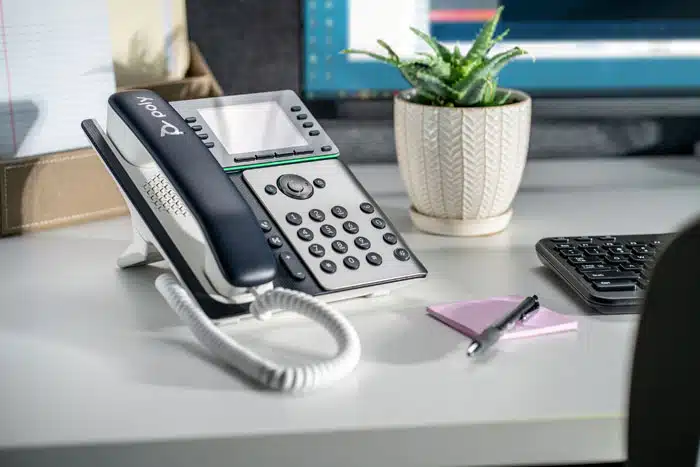
Anatomy of a Focused Desk: Why a Real Phone Earns Its Spot
The desk setups going viral in 2026 aren’t the ones with the most gear – they’re the ones that feel calm and considered. Bare surfaces, an “analog zone,” and tech that disappears into the room. It’s the same instinct driving vinyl, film cameras, and dumbphones: people want tools that do one thing well and don’t fight for their attention. Here’s what a genuinely focused desk looks like – and why a real desk phone, not another app on your laptop, belongs on it.
The 6 parts of a focused desk
A clear surface
The 2026 desk trend is less clutter, more intention. Open space isn’t empty – it’s room to think.
An “analog zone”
A notebook and a pen for planning. A physical reset that pulls you out of the screen for a minute.
One screen, not five
A single monitor for the task at hand – not a wall of dashboards each blinking for attention.
A real desk phone
The single-purpose device that does exactly one job – connect a call – the instant you lift the handset. No lock screen, no notifications, no “just checking something” mid-call. It’s the analog-minded tool that actually belongs in a modern office.
Your smartphone, face-down or away
Research found the mere presence of your smartphone drains focus even when you never touch it. A focused desk gives it a place to rest, not a place of honor.
A little nature
A plant, natural light. Small things, but they measurably help focus and make the desk somewhere you actually want to sit.
Why the desk phone is the quiet hero here
Every other “focus” tool on the desk works by removing a distraction. The desk phone is the rare one that adds a capability while staying distraction-free. It rings, you answer, you hang up – and nothing about it tempts you to scroll. For anyone who lives on calls – reception, support, sales, a busy front office – that’s the difference between a tool and a trap.
It’s the same logic behind a record player or a film camera: a device built for one purpose, owned outright, reliable, and pleasant to actually use. We make the full case in why a real desk phone still beats an app for focus at work, and we break down which roles need a desk phone versus a calling app in desk phone vs. app: do you still need one?
Want a phone setup that helps your team focus?
We design the right mix of real desk phones and calling apps and install it on-site, on one reliable system. See the handsets we install on business desk phones.
Get a Free Quote Schedule a ConsultationFAQ: The focused desk
What makes a desk good for focus?
A focused desk keeps clutter and distractions low and intentional tools high: a clear surface, a single screen for the task at hand, an analog zone with a notebook, a real desk phone for calls, your smartphone away or face-down, and a touch of nature. The goal is a space where tools do one job and don’t compete for your attention.
Why keep a desk phone instead of just using your smartphone or an app?
A desk phone is a single-purpose device with no notifications or apps competing for attention, so it supports focus rather than fragmenting it. Research shows the mere presence of a smartphone reduces available focus even when unused. For people who take a lot of calls, a desk phone is the reliable, distraction-free tool.
Is this just nostalgia, like vinyl records?
It overlaps with the same trend – a preference for purpose-built, owned, tactile tools – but the desk-phone case is practical, not just aesthetic. Consistent call quality, instant answering, a clean work/life line, and resilience with cellular data network failover are real operational benefits, especially for call-heavy roles.