My Business Phones Stopped Working and I Don’t Know Who to Call
Your phones stopped working. You called the number on the back of the handset — and the person who answered said they can’t access your system. Now you’re on hold with someone who can’t help you. If this sounds familiar, you’re not alone. The fix starts with one question.
The Problem Nobody Warned You About
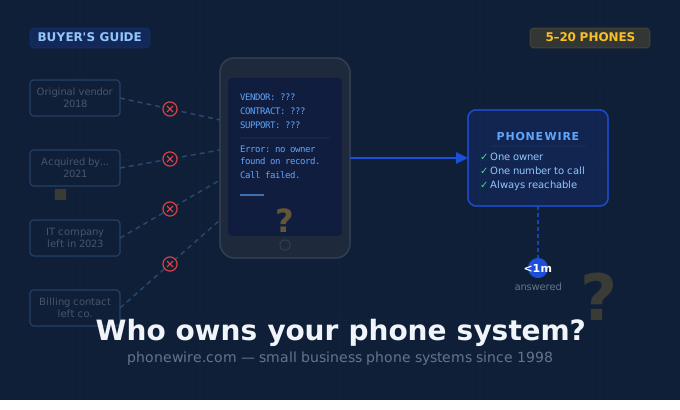
Most small businesses — especially those with 5 to 20 phones — reach a moment where something breaks, they try to get it fixed, and they discover that nobody they can reach actually owns the problem. The phones were installed by a vendor years ago. That vendor may have been acquired. The IT person who set it up left the company. The system is registered to a phone number that goes to voicemail. The billing statement is on a credit card that belonged to the previous office manager.
This situation is more common than you’d think. It’s not negligence — it’s a predictable consequence of how business phone systems have historically been sold. A technician shows up, installs the equipment, configures the system, and departs. The configuration is locked to their infrastructure. When something goes wrong, the only people who can fix it are the people who set it up — and if you don’t know who that was, or they’re no longer accessible, you’re stuck.
Your First Three MovesHow to Figure Out Who Owns It — Right Now
Start with these three questions. You may not need all of them — often the answer surfaces quickly.
Who pays the phone bill?
Pull up your banking or credit card statements and search for monthly recurring charges from telecom companies. The company that bills you monthly for phone service is most likely the company that controls your system’s configuration.
If multiple charges appear, or charges you don’t recognize, the system may have been migrated without a full transition — both providers may have partial ownership of different pieces.
Has your company changed internet or IT vendors in the last few years?
When a business switches internet service providers or IT management companies, the phone system often gets caught in the middle. VoIP systems depend on internet connectivity and are frequently managed by whoever manages the network.
Is there a previous office manager, IT person, or original vendor who set this up?
In small businesses, institutional knowledge walks out the door when employees leave. If your system was installed by someone who no longer works there, they may have left without transferring ownership of admin credentials, the service agreement, or number registrations.
What to search for in billing statements
Look for any of these keywords: “SIP,” “VoIP,” “hosted PBX,” “business lines,” “DID numbers,” “trunk” — or these company names: Vonage, RingCentral, 8×8, Nextiva, Lumen, Comcast Business Voice, Spectrum Business Voice, AT&T Business Voice, or any local telecom provider. The matching statement is your first phone call.
Why This Matters Beyond Today’s Problem
A single phone outage is inconvenient. But ownership confusion has a compounding cost that goes well beyond the hour you spend on hold. Consider what happens when:
In every one of these situations, the answer begins with the same question: who owns the system? If you don’t know, every task becomes a scavenger hunt. That’s not a technology problem — it’s a structural one. And it’s entirely solvable.
What Ownership Actually MeansWhat “Owning” Your Phone System Actually Means
When we talk about ownership, we mean something specific — not just “who made the hardware.”
That’s not a high bar. But for a surprising number of small businesses with 5 to 20 phones, it’s not the current reality.
The Right Fix for Small Offices
At 5 to 20 phones, the solution that eliminates this problem permanently is a managed phone system under one provider. One company installs the hardware, configures the system, owns the admin credentials, answers the support line, and is contractually accountable for uptime and changes.
When something breaks, there’s no question about who to call. When you need a change, there’s no question about who can make it.
This is exactly how Phonewire works. Every client gets a direct relationship with the team that built their system, a U.S.-based helpdesk that answers in under a minute, and day-to-day change requests handled at no additional charge. There is no ambiguity about who owns your system. We do. And you know how to reach us.
What to Do If Your Phones Are Down Today
Here’s the fastest path to a resolution — in order.
The goal isn’t to switch your phone system today. The goal is to end the uncertainty — so you know exactly who owns what and where to call.
Timing MattersA Word on When to Make This Decision
If you’re down right now
Don’t make long-term decisions during an emergency. Get calls working first. Assess your support structure once you’re stable — you’ll make better decisions from a position of calm than from a position of panic.
If nothing is broken yet
That’s the ideal time. A 15-minute conversation is all it takes to confirm whether your phone system ownership is clean and your support structure is solid — before you’re forced into a rushed decision.
Most businesses don’t evaluate their phone system until something breaks. The ones that do it proactively have time to ask questions, compare options, and negotiate from a position of choice rather than desperation.
Not Sure Who Owns Your Phone System?
Phonewire offers a free, no-obligation ownership check. We’ll help you identify who controls your numbers, whether there’s a contract in place, and what it would look like to have everything managed under one roof — no scavenger hunt required.
📞 (800) 857-1517 — answered in under 1 minute