5 Types of Business Phone Systems: A 2026 Buyer’s Guide
Not all business phone systems are built the same — and the right choice depends entirely on your size, budget, growth plans, and how much you want to manage. This guide breaks down the five types of phone systems available to small businesses in 2026, including an honest assessment of what’s changed in the market since many of these categories were first defined.
The Market Has Changed Substantially
The last decade reshaped the business phone system market more than any period since the invention of the PBX. Several major brands that dominated small business telecommunications for decades have filed for bankruptcy, been acquired, or exited the market entirely. Cloud-hosted phone service — essentially nonexistent as a mainstream option when many buyer’s guides were written — is now the dominant deployment model for new installations.
A 2013 phone system buyer’s guide tells you almost nothing useful in 2026. This one doesn’t. Here are the five categories that actually exist in today’s market, what’s changed in each, and how to choose.
At a Glance: The Five Types
| Type | Examples | Upfront Cost | Monthly Cost | 2026 Verdict |
|---|---|---|---|---|
| Legacy On-Premises PBX | Avaya IP Office, NEC UNIVERGE (if available) | High ($3,000–$15,000+) | Low (SIP trunks only) | ⚠ Avoid |
| Enterprise UCaaS | Microsoft Teams Phone, RingCentral, Webex | Low–None | High ($25–$45+/user/mo) | Enterprises only |
| Modern Hybrid On-Prem | Phonewire P560 + SIP Trunks | Moderate ($4,999 + install) | Low ($200/mo SIP for 20 users) | ✓ Best value |
| Cloud-Hosted PBX | Phonewire Cloud-Hosted | Low (install only) | Moderate ($35/user/mo) | ✓ Recommended |
| DIY / Open Source | FreePBX, Asterisk (Sangoma) | Low (hardware only) | Very low (SIP trunks only) | IT staff required |
The Five Types in Detail
Legacy On-Premises PBX
Traditional hardware PBX systems from established enterprise telephony brands
⚠ Avoid for new purchasesFor decades, brands like Avaya, NEC, Toshiba, Panasonic, and Mitel dominated the business PBX market. Their systems were reliable workhorses — expensive to purchase and maintain, dependent on proprietary hardware, but stable and well-understood. For large enterprises, this was the only real option.
In 2026, this category looks very different than it did ten years ago:
- Toshiba Telecommunications — exited the U.S. business phone market in 2017. Legacy support only.
- Panasonic — discontinued its business telephone product line ~2022–2023. No new development or replacement path within the brand.
- Mitel — filed Chapter 11 bankruptcy protection in 2023 and was acquired. Future product roadmap uncertain.
- ShoreTel — acquired by Mitel in 2017. Brand discontinued.
- NEC UNIVERGE — NEC sold its unified communications division to an investment group in 2023. Availability and long-term support uncertain.
- Avaya — filed for bankruptcy twice (2017 and 2023). Avaya IP Office still sold through channel, but with significant EOL risk.
The result: businesses that installed legacy PBX systems in the 2010s are now managing aging hardware from companies that may no longer exist in their original form, with shrinking support networks and no future development. The per-user licensing costs on surviving platforms (Avaya Cloud Office, Avaya’s cloud subscription platform, runs approximately $25/user/month before taxes — about $32/user/month after typical U.S. telecom taxes) add up quickly alongside legacy trunk costs.
For businesses currently running legacy PBX: the question is no longer whether to migrate, but when and to what.
Historical Strengths
- Reliable, proven over decades
- Rich feature sets for large enterprises
- Familiar to IT departments
2026 Reality
- Multiple vendors bankrupt or EOL
- High per-user licensing costs
- Dependent on expensive legacy trunks
- No migration path for discontinued brands
- Shrinking support/technician availability
Enterprise UCaaS Platforms
Large-scale cloud communications platforms built for distributed enterprises
Enterprises — expensive for small businessesUnified Communications as a Service (UCaaS) platforms like Microsoft Teams Phone, RingCentral MVP, Cisco Webex Calling, and 8×8 X Series have absorbed much of the enterprise market that legacy PBX systems previously owned. These platforms offer voice, video, messaging, and collaboration in a single cloud-delivered suite — plus deep integration with other enterprise software.
The challenge for small businesses is cost. Enterprise UCaaS pricing runs $25–$45+ per user per month at base tiers, with meaningful features (advanced call routing, contact center capabilities, CRM integration) typically requiring higher tiers at $35–$60+ per user. For a 20-user business, that’s $600–$1,200 per month in subscription fees alone — before any hardware costs.
These platforms are also built around enterprise use cases. The configuration complexity, administrator portal depth, and feature surface area of Microsoft Teams Phone or RingCentral is significant overhead for a 15-person professional services firm that needs phones, voicemail, and an auto-attendant. The capabilities exist — but paying for and managing them often isn’t proportionate to the benefit for smaller organizations.
Cisco, notably, pulled back from the small business phone system market in 2013 and has remained primarily an enterprise and mid-market player. Teams Phone requires a Microsoft 365 Business Voice add-on and meaningful IT infrastructure investment to deploy correctly.
Strengths
- All-in-one voice, video, messaging
- No hardware to manage
- Deep integrations (CRM, Microsoft 365)
- Scales to thousands of users
Drawbacks for Small Business
- $25–$60+/user/month adds up fast
- Complex administration for small teams
- Features overkill for most SMBs
- Vendor lock-in at enterprise scale
- Call quality dependent entirely on internet
Modern Hybrid On-Premises System
Contemporary on-premises PBX with cloud management and SIP trunking — the best total cost option for most small businesses
✓ Best value for most small businessesThe modern hybrid on-premises system is where the market has landed for small businesses that want the control and reliability of on-premises hardware without the cost structure of legacy enterprise platforms. The concept: a compact, software-driven PBX appliance installed on your premises, managed through a web browser, updated continuously via software, and connected to affordable SIP trunks rather than expensive legacy phone lines.
Phonewire installs and supports the Phonewire P560 as its flagship on-premises system — a professional-grade PBX appliance supporting up to 200 users with full UC features: call routing, voicemail to email, auto-attendant, call queues, call recording, mobile and desktop apps (Linkus UC Clients), Microsoft 365 integration, and built-in failover that keeps calls working even when your internet goes down.
The economics are significantly better than legacy alternatives. The P560 hardware is a one-time purchase ($4,999). The Enterprise Plan annual license is $999/year — flat regardless of user count, covering up to 10 users. SIP trunks for a 20-user business run approximately $200/month for 8 channels of unlimited calling. Over five years, total cost of ownership depends on your configuration — contact Phonewire for a 20-user quote. A comparable legacy Avaya or Panasonic deployment runs approximately $65,000–$83,000 over the same period. See our 5-year TCO comparison for the full breakdown.
The other key advantage: the hardware runs the same software platform as Phonewire’s cloud-hosted option, so migrating between on-premises and cloud later requires no retraining, no new phones, and no new configuration.
Strengths
- Best 5-year total cost for most SMBs
- Works without internet (failover)
- Hardware on your premises — you control it
- Flat annual license — not per-user
- Full UC features included
- Professional installation by Phonewire
Considerations
- Hardware upfront cost ($4,999)
- Requires structured cabling for desk phones
- Annual license renewal required
Cloud-Hosted PBX
Fully managed, professionally deployed cloud phone service — no on-premises hardware
✓ Recommended — especially for multi-site and remote teamsCloud-hosted PBX is the fastest-growing deployment model in the small business market — and the one that was entirely absent from most buyer’s guides written before 2015. The concept: your PBX lives in the cloud (on Phonewire’s managed infrastructure), your phones connect over your internet connection, and you get the same features as an on-premises system with zero hardware to manage on-site.
Phonewire’s cloud-hosted option runs on the same platform as the on-premises P560 — same features, same admin interface, same Linkus UC mobile and desktop apps. The difference is where the system lives. Cloud-hosted means no appliance to purchase, no server to maintain, and no capacity ceiling to worry about as you grow.
The tradeoff is a higher monthly cost: at $35/user/month for 20 users, the five-year subscription total is approximately $42,000 — higher than the on-premises option, though still meaningfully less than legacy alternatives. Cloud-hosted also requires internet connectivity for all calls — Phonewire recommends maintaining a secondary internet connection (a cellular backup, for example) for businesses where phone uptime is critical.
For multi-location businesses, cloud-hosted is typically the right answer: all offices run on the same system with no per-location hardware and a single admin interface for everything.
Strengths
- No hardware purchase required
- Instant scalability — add users same day
- Single system across multiple locations
- Professionally managed by Phonewire
- Same features as on-premises P560
Considerations
- Higher monthly cost vs on-premises
- Internet-dependent (plan for backup)
- No hardware ownership
DIY / Open Source
Self-built, self-managed systems based on open-source software — FreePBX, Asterisk
IT staff required — not for most small businessesThe open-source telephony ecosystem is built on Asterisk — the open-source PBX software that Digium created and open-sourced in 1999. Digium was acquired by Sangoma Technologies in 2018, and Sangoma now maintains both the open-source Asterisk project and commercial products built on top of it (FreePBX, PBXact, and the Switchvox commercial appliance).
The free route (FreePBX + Asterisk) allows a business to build a feature-complete phone system for approximately the cost of a server and SIP trunks. The tradeoff is exactly what it has always been: you become your own phone company. Installation, configuration, troubleshooting, updates, security patching, and support are all your responsibility. Linux knowledge is required. When something breaks — and complex telephony systems do occasionally break — there is no vendor to call.
For businesses that have the in-house technical capability to manage this, open source can be a very cost-effective option. For the majority of small businesses without dedicated IT staff, the hidden cost of managing a DIY phone system — in staff time, troubleshooting delays, and eventual consultant fees — typically exceeds the savings over a professionally installed and supported system.
Sangoma’s commercial products (PBXact, Switchvox) add a management layer and support contract on top of the open-source foundation — bridging the gap between pure DIY and a professionally managed system, at a cost that’s competitive with the Phonewire P560. A similar do-it-yourself path exists with 3CX — though many small businesses are now moving away from 3CX as it shifts focus upmarket.
Strengths
- Lowest upfront software cost (free)
- Maximum flexibility and customization
- No per-user licensing
- Large community and documentation
Considerations
- Requires Linux and Asterisk expertise
- No professional support included
- You are responsible for security updates
- Hidden cost: IT staff time
- No one to call when it breaks
How to Choose
The right phone system comes down to three questions:
If you are currently running a legacy Avaya, Panasonic, Toshiba, Mitel, or NEC system — the answer is different: the question isn’t which new system to buy but how soon to migrate and to what. All of those platforms are end-of-life or moving toward it. The longer the delay, the higher the risk that a failure forces a rushed, expensive migration rather than a planned one.
Frequently Asked Questions
Are Avaya and Mitel still good choices for small businesses?
No — for new installations in 2026, we don’t recommend either. Avaya has filed for bankruptcy twice (2017 and 2023), and its hardware and licensing costs are among the highest in the market. Mitel also filed for Chapter 11 bankruptcy protection in 2023. Both platforms carry significant end-of-life risk. Businesses currently running Avaya or Mitel should be planning a migration, not extending their investment. The same applies to other discontinued lines like NEC’s UNIVERGE systems, the AT&T Synapse and Vodavi Starplus families.
What happened to Digium Switchvox?
Digium was acquired by Sangoma Technologies in 2018. Switchvox is now a Sangoma product and continues to be sold and supported. The open-source Asterisk project, also maintained by Sangoma, remains the foundation of FreePBX and numerous other telephony products. Phonewire previously deployed Switchvox systems and can still support existing Switchvox installations. If you’re running one today, see our Switchvox replacement and migration options.
Is cloud-hosted or on-premises better for small business?
For most single-location small businesses with a three-plus year horizon, the Phonewire P560 on-premises system has the lower total cost of ownership over five years versus cloud-hosted (approximately $42,000–$46,000 for a 20-user cloud deployment) — contact Phonewire for an exact on-premises quote at your user count. Cloud-hosted is the better choice for multi-location businesses, remote/hybrid teams, and situations where no hardware management is available on-site. Phonewire offers both, and will recommend the right fit based on your specific situation.
Does a business phone system still need desk phones?
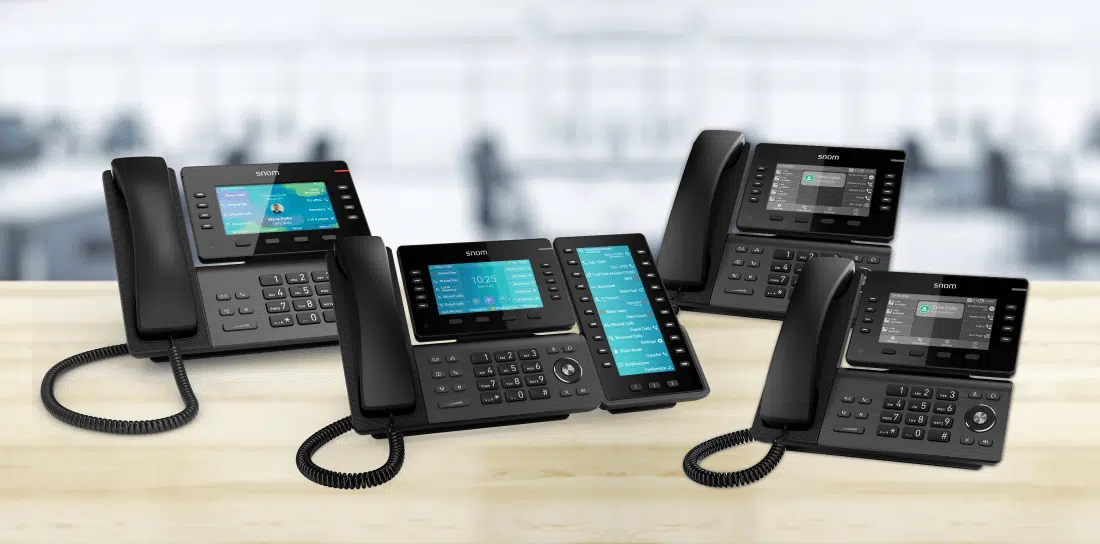
Not necessarily. Modern phone systems like the Phonewire P560 and cloud-hosted option include mobile apps (Linkus for iOS and Android) and desktop softphones that turn any computer or smartphone into a business extension. Many businesses run a hybrid setup: reception and key staff have desk phones, while field staff and remote workers use the mobile app. Desk phones from Snom, Yealink, and Poly are available through Phonewire for installations where physical phones are needed.
What is the total cost of a business phone system for 20 users?
The five-year total cost of ownership for a 20-user business varies significantly by type. Legacy on-premises (Avaya/Panasonic): approximately $65,000–$83,000. Phonewire P560 on-premises + SIP trunks: contact Phonewire for a 20-user quote. Phonewire cloud-hosted: approximately $42,000–$46,000. See our full 5-year TCO comparison for a detailed line-item breakdown.
What are the main types of business phone systems?
There are five main types in use today: legacy on-premises PBX (aging hardware like Avaya or Mitel), enterprise UCaaS platforms, modern hybrid on-premises systems, cloud-hosted PBX, and DIY/open-source setups. Most small businesses now choose either a modern hybrid system or a cloud-hosted PBX. See the full breakdown of all five types of business phone systems above for how they compare on cost, control, and scalability.
Not Sure Which Type Is Right for Your Business?
Phonewire installs both on-premises and cloud-hosted systems for small businesses nationwide — and will give you a straight recommendation based on your size, location, internet reliability, and budget. No pressure, no upsell. Just the right system for how your business operates.
📞 (800) 857-1517