AT&T Copper Shutdown — Fire Alarm & Elevator Phone POTS Replacement
Most businesses think of their copper POTS lines as phone lines. But for many commercial buildings, the lines that are most at risk from AT&T’s copper retirement aren’t connected to phones at all — they’re connected to fire alarm panels, elevator emergency phones, security systems, and fax machines. When those lines go dark, the consequences aren’t just an inconvenience. They’re a code violation, an insurance exposure, and in some cases, a building shutdown order.
Who this is for. Phonewire replaces elevator and emergency phone lines in commercial buildings and in multi-family condo and HOA properties. We don’t take on single-family homes. If the landline for your home elevator is being retired, your elevator service company or the elevator’s manufacturer can supply a cellular dialer for it.
Where AT&T’s Copper Retirement Stands Right Now
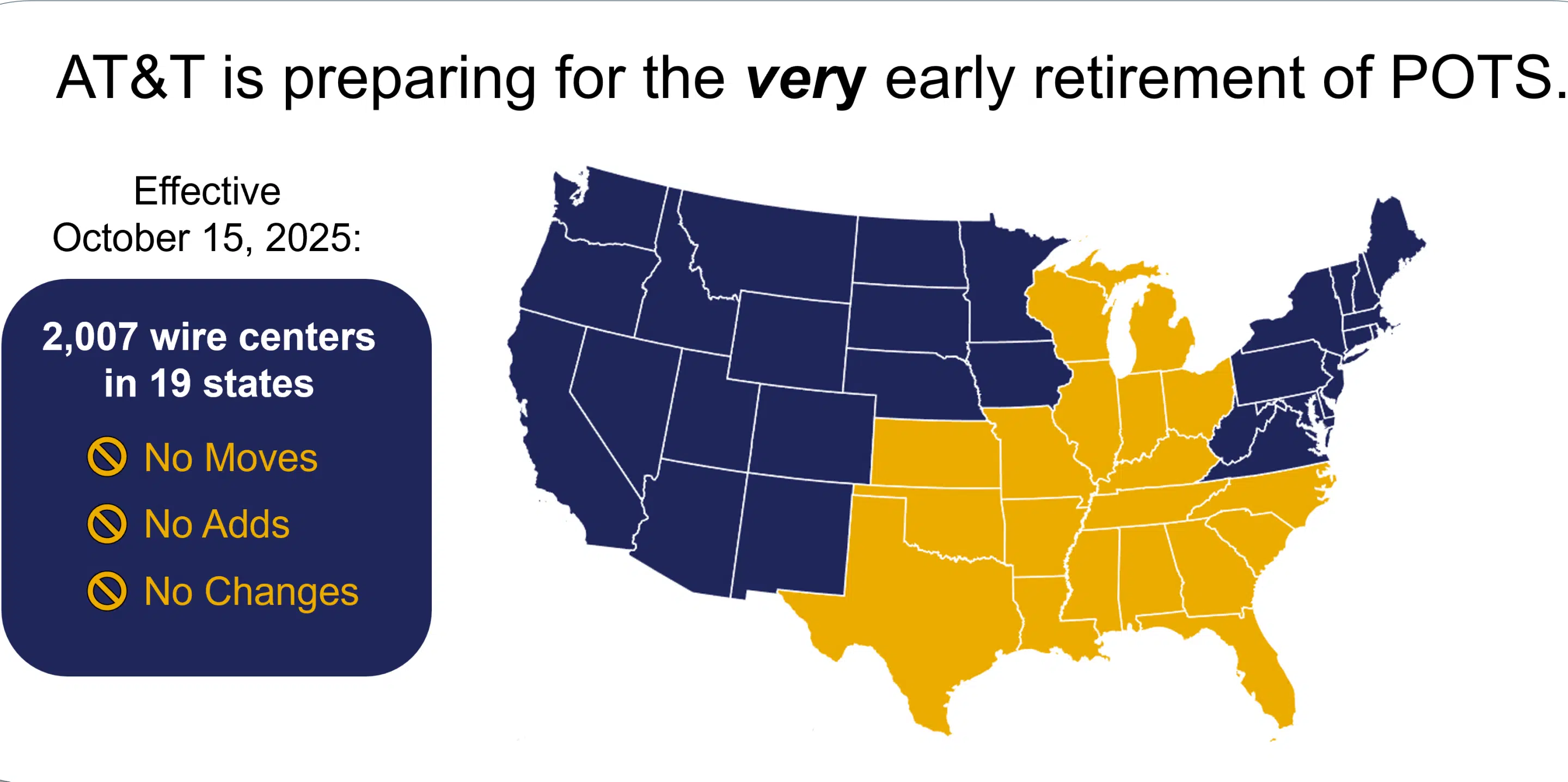
The October 15, 2025 milestone has passed — AT&T no longer accepts new orders, moves, or changes to copper POTS lines across approximately 1,711 wire centers in 19 states. But the more significant deadline is still ahead:
June 2026: AT&T begins decommissioning copper facilities across roughly 500 wire centers nationwide. When a wire center is decommissioned, every POTS line it serves is terminated permanently. No forwarding. No grace period. The line is gone.
November 2026: A separate AT&T filing seeks authority to discontinue POTS for approximately 90,000 customers across 18 states.
2029: AT&T’s stated target to retire virtually all remaining copper services nationwide.
The Systems Most at Risk — and What Happens When the Line Goes Dark
Fire Alarm Panels
Most commercial fire alarm systems use a Digital Alarm Communicator Transmitter (DACT) that sends alarm signals over a phone line to a central monitoring station. The POTS line is the communication path. When the line goes dark, the DACT loses that path.
NFPA 72, the National Fire Alarm and Signaling Code, governs how fire alarm systems must communicate. A system that loses its primary communication path enters a supervisory fault condition. Depending on the authority having jurisdiction (AHJ) in your area, this can result in a citation during the next annual inspection, a requirement to post a fire watch, or an order to restore communication within a specified timeframe.
The replacement: Cellular communicators that plug into the existing DACT or replace the analog communication module. The fire alarm panel stays in place — only the communication path changes. These devices meet NFPA 72 requirements and typically include a backup battery to maintain compliance during power outages.
Elevator Emergency Phones
ASME A17.1, the Safety Code for Elevators and Escalators, requires every elevator cab to have a two-way emergency communication system that connects to a monitoring point. Most elevator emergency phones in older buildings connect through a POTS line. When that line is retired, the elevator’s emergency communication system goes silent.
Elevator inspectors test emergency phone connectivity as part of their standard annual inspection. An elevator with a non-functional emergency phone fails inspection. In many jurisdictions, a failed elevator inspection results in an order to take the elevator out of service until the issue is corrected. For a multi-tenant commercial building or a hotel, an out-of-service elevator is an immediate operational and liability problem.
The replacement: Phonewire’s elevator phone service replaces the copper POTS line with a cellular-connected emergency phone unit that meets ASME A17.1 requirements. The existing cab phone hardware can often be retained — only the communication path changes. Phonewire handles the installation and ensures the system passes inspection before the project is closed.
Security and Intrusion Alarm Panels
Security alarm panels — burglary, intrusion, access control — commonly use POTS lines to communicate with monitoring centers. When the line is retired, the panel loses its communication path. Depending on how the monitoring contract is configured, this may trigger a false alarm condition, cause the monitoring contract to lapse due to a communication failure, or leave the facility effectively unmonitored without anyone knowing.
Property insurance policies often require functioning burglar and fire alarm monitoring as a condition of coverage. A documented communication failure may create grounds for a coverage dispute on a claim. The insurance consequence alone makes this a risk worth addressing proactively.
The replacement: Cellular communicator added to the existing alarm panel — the panel itself stays in place. Most alarm monitoring companies handle this directly, but if your monitoring company hasn’t contacted you about copper retirement, initiate that conversation now.
Gate, Door Access, and Emergency Call Boxes
Entry intercoms, parking gate call boxes, and campus emergency blue-light phones that dial a number to connect a visitor or trigger a response often run on dedicated POTS lines. When the line is retired, the call box stops working. For a campus or multi-building facility, a non-functional emergency call box is both a safety gap and, depending on local code, a compliance violation.
The replacement: Cellular-capable intercom and call box units that connect over LTE instead of copper, or VoIP-connected intercoms if the facility has adequate network coverage at the access point. Phonewire assesses and quotes these as part of a broader POTS line audit.
Fax Lines and Point-of-Sale Systems
Medical offices, law firms, real estate offices, and healthcare facilities still commonly rely on fax for document transmission — often for regulatory or compliance reasons. POS payment terminals and ATMs in some installations also use POTS lines for transaction processing.
For fax lines, the replacement is typically an internet fax service or an analog telephone adapter (ATA) that connects the existing fax machine to VoIP service. For POS and ATM lines, the payment processor or ATM service provider typically handles the replacement — but identifying that these lines exist and flagging them is the first step.
Not sure which of your copper lines are life-safety lines vs. voice lines? Phonewire will walk through your current phone bill and building systems and tell you which lines are at risk and what each replacement looks like. Free assessment.
Schedule a Free Assessment →How to Get Ahead of the June 2026 Deadline
The organizations that handle copper retirement cleanly are the ones that act before the notice arrives — not after. Here’s what to do now:
Step 1 — Audit every copper line on your bill. Pull your AT&T or carrier phone bill and identify every line. Note what each one connects to: phone system, fax machine, fire alarm panel, elevator, security panel, gate access. Many building owners are surprised by how many lines they have and what they’re actually serving.
Step 2 — Identify compliance exposure. For any line connected to a fire alarm panel or elevator emergency phone, losing that line is a code violation, not just an operational issue. Flag those lines as highest priority and address them first.
Step 3 — Contact your alarm and elevator service companies. Your fire alarm monitoring company and elevator maintenance contractor should both be proactively addressing copper retirement with their customers. If they haven’t contacted you, call them. Confirm the replacement plan for your specific panel and elevator model.
Step 4 — Replace voice phone lines with VoIP. If your business phone system still runs on copper POTS lines, that’s a separate replacement project — one that often saves money immediately. Phonewire replaces copper-dependent phone systems with modern VoIP, typically in a single installation day. See the complete guide to POTS line replacement for business phone systems.
Step 5 — Don’t wait for a shutdown notice. By the time you receive a 90-day notice, the timeline to assess, quote, order, install, and test a replacement for code-critical systems is already extremely tight. Acting now gives you the ability to plan on your schedule, not AT&T’s.
Running an office of 5 to 40 phones on copper? That is the size of office Phonewire’s hosted plans are built around: one location, a receptionist, a fax line, maybe an alarm panel, and a copper bill that keeps climbing. A system for that size is installed on-site over the wiring you already have, and the copper lines go away with it — elevator and alarm lines included, moved to cellular.
See what a small office phone system includes →Audit Your POTS Lines Before the Next Deadline
Phonewire helps businesses identify every copper line at risk, prioritize life-safety replacements, and complete the transition before a shutdown notice forces a rushed installation. Free consultation, specific recommendations, same-day quotes.
Schedule a Free Consultation See our elevator phone service →