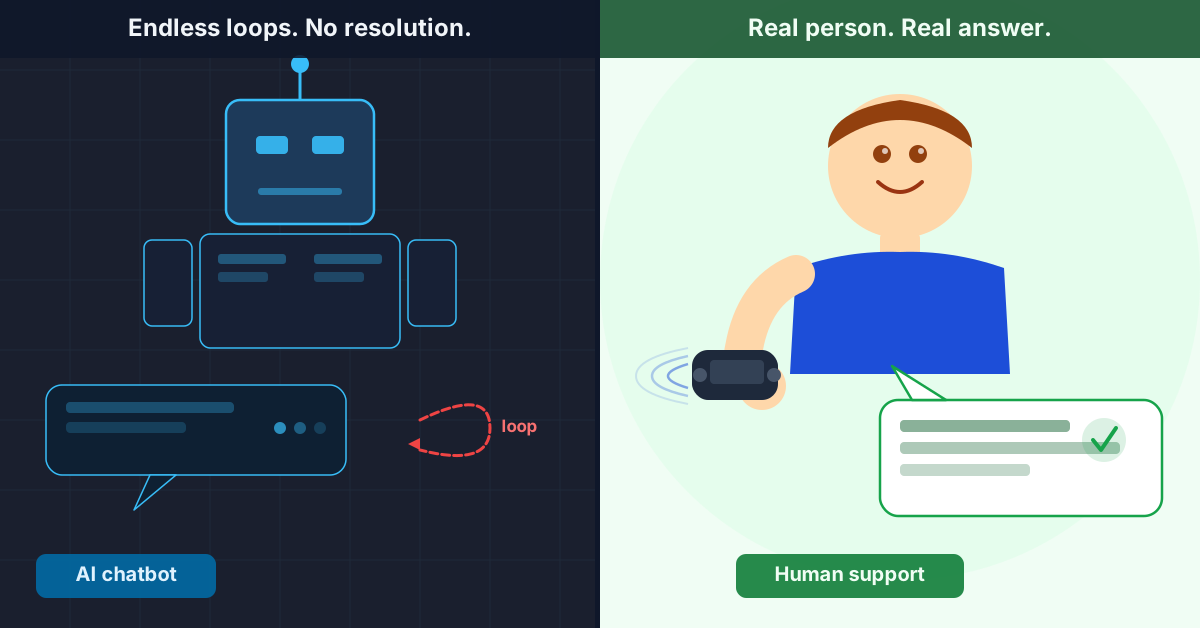
AI is everywhere in business right now — in customer service chatbots, in automated phone systems, in “smart” answering services that promise to handle inquiries 24 hours a day. The sales pitch is compelling: lower costs, instant responses, no hold times. For large companies handling thousands of identical customer interactions per day, some of that pitch is true.
For small businesses, the calculation is different. Your customers aren’t calling to check an order status or reset a password. They’re calling because something went wrong, because they have a question that doesn’t fit a FAQ, or because they want to talk to someone who knows their account. That’s a fundamentally different kind of customer service interaction — and it’s one where the disadvantages of AI systems become very real, very fast.
This isn’t an argument against technology. It’s an honest look at where AI customer service works, where it doesn’t, and why small businesses with high-touch customer relationships should think carefully before replacing human touchpoints with automated ones.
6 Genuine Disadvantages of AI Customer Service for Small Businesses
These aren’t theoretical concerns. They’re the patterns that show up consistently in businesses that have implemented AI customer service and then either rolled it back or hedged it with human backup.
The Endless Loop Problem
AI systems are good at handling the questions they were trained for. Everything else becomes a loop.
AI chatbots and automated phone systems operate from a training set — a defined universe of questions they know how to handle. When a customer’s question falls outside that universe, the system doesn’t admit it doesn’t know. It cycles through related options, asks clarifying questions, and redirects — while the customer’s frustration builds with each pass.
For small businesses, customer questions are often specific, contextual, and non-standard. “I talked to someone last Tuesday about my invoice and she said you’d credit the overage” isn’t in any chatbot’s training set. Neither is “we’re a law firm and we need the after-hours routing changed before Monday because we have a filing deadline.” Those calls need a human who understands the account and has the authority to help.
You’re Legally Responsible for What Your AI Says
AI can confidently give wrong information — and courts have ruled the business is liable for it.
In 2024, Air Canada was ordered by a tribunal to compensate a passenger after its chatbot gave incorrect information about bereavement refund policies. The company argued the chatbot was a “separate legal entity” responsible for its own statements. The tribunal rejected this argument entirely: if it’s on your platform, it’s your statement, and your liability.
For small businesses, the risk is acute. An AI answering system that quotes the wrong price, misrepresents a return policy, makes a promise the business can’t keep, or gives incorrect information about a service creates real legal exposure — with no “the AI said it, not me” defense available.
AI Signals That Customers Are a Cost to Minimize
Customers read the message behind the technology — and they respond to it.
When a large company routes you through an AI chatbot, you accept it as the price of dealing with a large company. When a small business routes you through an AI chatbot, the message is different: we can’t be bothered to hire someone to talk to you.
Small businesses differentiate from national competitors on relationship and responsiveness. A customer who calls a local law firm, medical practice, plumbing company, or accounting office and reaches a bot is receiving a clear signal about their value to that business. The businesses that thrive on repeat clients and referrals — which describes most small businesses — cannot afford to send that signal, regardless of what the AI costs per month.
AI Cannot Handle Urgency the Way a Human Can
Tone, context, and emotional register are invisible to automated systems.
A human support person knows within the first few seconds of a call whether something is routine or urgent. Tone of voice, word choice, the fact that someone is calling at 7am on a Monday — these signals shape how a skilled support person responds. They can escalate, break protocol, find a workaround, or simply reassure someone who is stressed.
AI systems process the words, not the context. A panicked call about a phone system being completely down gets the same scripted response flow as a routine request to add a new extension. For businesses where a system outage or service failure is a genuine emergency — medical offices, law firms, financial services — the inability of AI to recognize and respond to urgency is a serious operational risk.
Implementation and Maintenance Costs Are Higher Than Advertised
AI customer service is not plug-and-play. The ongoing cost to do it well is significant.
The sales pitch for AI customer service focuses on the per-seat or per-interaction cost versus a human agent. What the pitch doesn’t include: the cost of initial setup and training data, the ongoing cost of reviewing and correcting AI errors, the engineering cost of integrating the system with your existing CRM or ticketing system, and the cost of the customer relationships damaged while the system is being tuned.
For large companies handling tens of thousands of standardized interactions, those implementation costs are amortized across enough volume to make sense. For a small business handling dozens of calls per day with high complexity and high stakes per interaction, the math usually doesn’t work — and the opportunity cost of damaged customer relationships is rarely factored in.
Data Privacy Exposure Is a Real and Growing Risk
AI systems process and store customer information at scale — with real compliance implications.
AI customer service systems operate by processing and learning from customer interactions. That processing requires storing conversation data, often across third-party platforms with their own security postures and data handling policies. For small businesses in regulated industries — healthcare (HIPAA), legal (attorney-client privilege), financial services — introducing an AI layer into customer communications creates real compliance questions that require real legal review.
Even for businesses not in regulated industries, the optics of data handling matter. Research shows 91% of organizations agree they need to do more to reassure customers about how their AI systems use data. For a small business built on trust and personal relationships, a data handling incident — even a minor one — can be catastrophic in a way it would not be for a large company with a PR team.
Where AI Actually Helps — and Where It Hurts
This isn’t a blanket argument against AI in business. AI is genuinely useful for specific, well-defined tasks that involve high volume, low complexity, and low relationship stakes. The mistake is applying it to tasks that require the opposite: low volume, high complexity, and high relationship stakes — which describes most small business customer service.
- Answering FAQs with consistent, predictable answers (hours, directions, pricing)
- Routing high-volume inbound contacts to the right department
- After-hours basic inquiry capture (“leave your name and number”)
- Appointment reminders and automated confirmations
- Transcribing voicemails into readable text for human review
- Drafting routine email responses for human review and editing
- Analyzing patterns in customer contacts to identify recurring issues
- Handling complex, contextual, or multi-part customer issues
- Any interaction where emotional tone matters (complaints, urgency, distress)
- Situations requiring account-specific knowledge or judgment
- High-stakes service industries (legal, medical, financial)
- Businesses where client relationships drive retention and referrals
- Calls involving pricing negotiations, exceptions, or policy decisions
- Any communication that could create legal or compliance liability
Why Phonewire Is Built Around Human Support
Phonewire has been installing and supporting business phone systems since 1998. In that time, we’ve watched the industry push toward automated support in ways that consistently frustrate the businesses on the receiving end of it. Our support model is deliberately different — and it’s a competitive differentiator our clients cite consistently.
- Answered in under 1 minute — every call, a real person, not a bot or a hold queue
- U.S.-based support — same team who installed your system knows your setup
- Day-to-day changes included — new users, routing changes, updated greetings — no per-incident billing, no ticket queue
- 24/7 availability coverage — emergency support when something is actually wrong, answered by someone who can act
- No automated runaround — you don’t press 1 for billing, 2 for technical, 3 for sales, then wait on hold for the right department
We do use technology — including voicemail transcription and automated notifications where they genuinely help. But the customer-facing support relationship at Phonewire is human, because that’s what small businesses need from a critical infrastructure partner.
The Right Question to Ask
Before implementing any AI customer service system, the right question isn’t “how much will this save per interaction?” It’s “what kind of customer relationship do we want, and what does that relationship require?”
For a business that runs on repeat clients, referrals, and professional reputation — a law firm, medical practice, financial advisor, contractor, or any company where one relationship can represent years of revenue — the human touchpoint in customer service isn’t a cost to cut. It’s a competitive advantage to protect.
AI has a role in business communications. That role is supporting human judgment, handling the genuinely routine, and freeing people up for the interactions that matter. It isn’t replacing the person who answers the phone when your most important client calls with an urgent problem.
A Phone System That Puts People First
Phonewire installs modern business phone systems and backs them with human support that answers in under a minute. Free consultation — same day quote, no obligation.
Schedule a Free Consultation See how our support works →