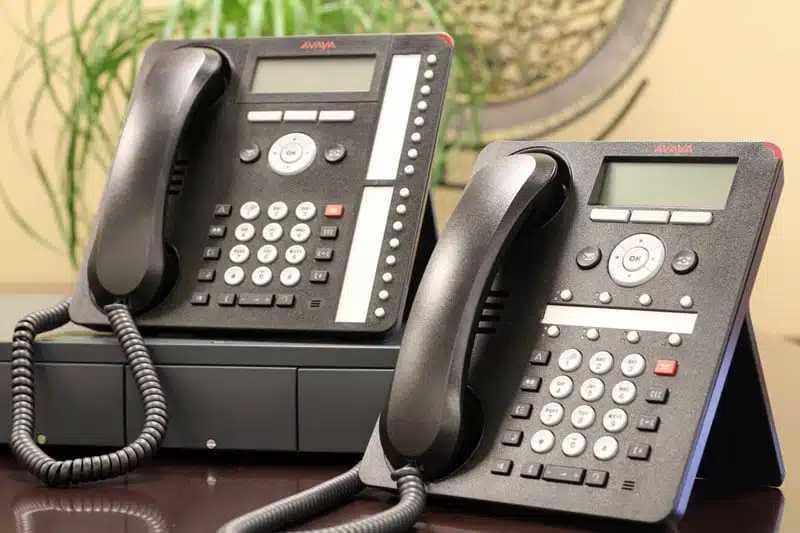
Avaya Bankruptcy: Two Chapter 11 Filings in Six Years, and What It Means for Your Phone System
Avaya has filed for Chapter 11 bankruptcy twice in six years — once in January 2017, and again in February 2023. It emerged from the second filing in May 2023 with roughly $650 million in fresh liquidity, and on paper the company looks stabilized. But the more revealing story isn’t the bankruptcies themselves — it’s what Avaya’s leadership has done since: pivot the company hard toward large-enterprise AI and customer-experience software, and away from the on-premises small-business phone systems, like IP Office, that built the company’s reputation in the first place. Here’s the full timeline and what it actually means if you’re running Avaya IP Office today.
The Avaya Bankruptcy Timeline
Avaya’s financial troubles trace back further than either bankruptcy filing. The company was spun off from Lucent Technologies in 2000 (Lucent itself had split from AT&T in 1995), then taken private in 2007 in an $8.2 billion leveraged buyout led by Silver Lake Partners and TPG Capital. That buyout loaded Avaya with debt it never fully worked off.
- January 19, 2017 — Avaya files for Chapter 11 under roughly $6 billion in debt. The company emerges later that year and returns to public markets.
- 2017-2022 — Avaya sells off its networking business to Extreme Networks and tries to build out cloud contact-center and collaboration products, but the pandemic-era rush to cloud communications favors newer, cloud-native competitors over Avaya’s still debt-heavy, largely on-premises business.
- July 2022 — Alan Masarek is appointed CEO.
- February 14, 2023 — Avaya files for Chapter 11 a second time, seeking to cut roughly $3.4 billion in debt down to about $800 million — a reduction of nearly 75%.
- May 1, 2023 — Avaya emerges from its second bankruptcy with its balance sheet deleveraged by approximately 75% and roughly $650 million in liquidity to fund operations going forward.
Is Avaya Going Out of Business?
No — Avaya has emerged from both bankruptcies and continues to operate as a private company. Two Chapter 11 filings in six years is a legitimate reason for caution, but it isn’t the same thing as a company shutting down. What’s more informative than the bankruptcies themselves is the strategic direction Avaya has taken since the second one, because that direction tells you a lot about where the company is investing — and where it isn’t.
Avaya’s Shift Away From Small Business
Since emerging in 2023, Avaya under CEO Alan Masarek has repositioned itself around the Avaya Experience Platform (AXP) — a cloud customer-experience and contact-center product aimed squarely at large enterprises. In 2026, Avaya extended that same direction with “Avaya Infinity,” an AI-driven customer-experience platform, and has been publicly promoting an “open for innovation” enterprise CX strategy. None of this messaging is built around the small-business, on-premises phone system market that products like IP Office serve. That’s not a minor branding shift — it’s a company that has twice restructured its balance sheet putting its post-restructuring investment behind large-enterprise cloud CX software, not premises-based SMB telephony.
What This Means for Avaya IP Office
Avaya IP Office already runs on a rolling support model: only the most recent handful of releases get full support, and anything on an older release is limited to “Basic Support” — no major upgrades, no proactive patching, no onsite support. Combine that existing support ceiling with a vendor that has filed bankruptcy twice in six years and has publicly redirected its strategy toward enterprise CX software, and the pattern is consistent rather than contradictory: Avaya isn’t hiding that small-business, on-premises telephony isn’t where it’s investing anymore.
None of this means an IP Office system stops working overnight — plenty of businesses run older, minimally-supported systems for years without incident. It does mean that if you’re already on an older IP Office release, or you’re evaluating whether to renew a support contract or buy new Avaya hardware, you’re making that decision about a vendor that has been financially unstable twice and has told the market, in its own words, where its future actually is — and it isn’t small business phone systems.
What Phonewire Installs as an Avaya IP Office Replacement
Phonewire doesn’t offer Avaya repair or support services — if your IP Office system is aging out or under-supported, replacement is the practical path, not a support contract with a vendor whose stated strategy has moved on. Every Avaya migration Phonewire handles includes: your existing phone numbers ported and live on the new system, the old Avaya system kept running until cutover day, full extension and call-routing configuration, same-day staff training, and ongoing U.S.-based support that answers the phone.
Evaluating other legacy vendors too? See the Mitel bankruptcy timeline, or read our 5-year cost comparison of legacy PBX vs. Phonewire.
Running Avaya IP Office? Get a Free Migration Assessment.
Phonewire will review your specific Avaya IP Office release, tell you exactly where it stands on support, and quote a replacement with specific pricing. Free consultation, same-day quote.
Schedule a Free Assessment See Avaya IP Office replacement options →Frequently Asked Questions
Has Avaya filed for bankruptcy more than once?
Yes. Avaya filed for Chapter 11 bankruptcy on January 19, 2017 under about $6 billion in debt, and again on February 14, 2023, this time cutting roughly $3.4 billion in debt down to about $800 million. It emerged from the second filing on May 1, 2023 with its balance sheet deleveraged by around 75%.
Is Avaya going out of business?
No. Avaya has emerged from both bankruptcies and continues to operate as a private company. Since 2023 it has focused its strategy on the Avaya Experience Platform and, as of 2026, “Avaya Infinity” — both aimed at large-enterprise customer experience, not small-business on-premises phone systems.
Is Avaya IP Office end of life?
Avaya IP Office runs on a rolling support model where only the most recent releases get full support; older releases fall back to Basic Support only, with no major upgrades and no onsite support. It isn’t a single hard end-of-life date, but older releases are effectively minimally supported today.
Is Avaya IP Office support still available for small businesses?
Formally, yes for systems on supported releases, but Avaya’s public strategy since its 2023 bankruptcy has centered on large-enterprise cloud CX products, not small-business on-premises telephony. That’s a signal about where future investment and development are headed, independent of whatever support currently exists on paper.
What is Avaya’s strategy now?
Since emerging from its second Chapter 11 in 2023, Avaya has repositioned around the Avaya Experience Platform and, more recently, “Avaya Infinity” — an AI-driven customer experience platform aimed at large enterprises. Its public messaging is built around enterprise CX, not the small-business on-premises phone systems that products like IP Office serve.