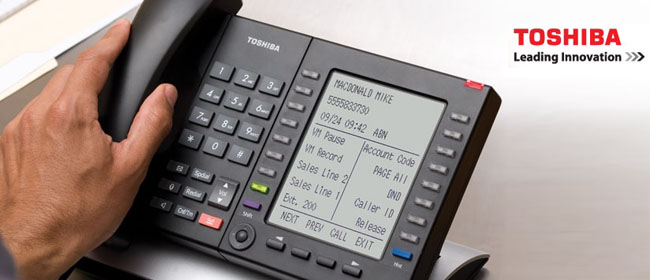
Toshiba Phone System End of Life — All Support Ended — Strata, IPedge Discontinued
In 2017, Toshiba announced the closure of its Telecommunication Systems Division. By October 2021, all support had ended completely. No manufacturer support. No new parts. No firmware updates. No security patches. Unlike some other legacy system exits — where an acquisition extended the timeline or a partial support path remained — Toshiba’s exit was absolute. If your business is still running a Toshiba Strata or IPedge system, you are running hardware with zero manufacturer support and a parts supply that depends entirely on what the secondary refurbished market has in stock.
The Toshiba EOL Timeline
2017: Toshiba Corporation announced the closure of its global Telecommunication Systems Division. The announcement covered all Toshiba business phone systems sold outside Japan, including the entire Strata and IPedge product lines.
2017–2021: Toshiba phased down operations. Hardware sales wound down. The dealer channel contracted significantly as certified Toshiba technicians moved to other platforms. Parts availability from Toshiba’s official channel progressively declined.
October 2021: All support ended. No manufacturer technical support, no hardware RMA, no software updates, no security patches. Toshiba’s telecom operations were fully closed.
There was no Forerunner-style acquisition to extend the timeline. No third-party company stepped in to continue the platform. The Toshiba business phone system product line is simply closed — more completely than any other major legacy system exit in the small business segment.
Toshiba Strata CIX and CTX Series
The Strata CIX (CIX40, CIX100, CIX200, CIX670, CIX1200) and the earlier Strata CTX were Toshiba’s most widely deployed small and mid-size business systems. These are hybrid analog/digital/IP platforms — many still running on analog station cards with Toshiba proprietary digital phones.
For Strata CIX users still on a functioning system: the practical risk is hardware failure with no replacement path. A failed CPU module, a failed line card, or a failed station card means either finding a refurbished replacement on the secondary market or replacing the system. The secondary market has some inventory but it’s depleting, and the pool of technicians who know these systems well enough to install a used module and configure it correctly is small and shrinking.
Phonewire migrates Toshiba Strata customers to modern VoIP systems that work with your existing wiring. The Strata stays live until cutover day. Your numbers port. See the Toshiba Strata replacement guide.
Toshiba IPedge
The IPedge was Toshiba’s most recent platform — a server-based IP PBX that launched in the 2010s and was genuinely competitive when it was released. It ran on Windows Server and offered a modern feature set. Many customers who invested in IPedge in the early 2010s did so with the expectation of a much longer supported lifespan.
Unfortunately, IPedge is in a more precarious position than the older Strata systems in one specific way: it depends on Windows Server versions that Microsoft has since discontinued or significantly changed. IPedge running on Windows Server 2008 or 2012 is running an OS that Microsoft no longer patches — layering an unsupported application on an unsupported operating system creates compounding security exposure.
The replacement path for IPedge customers is a full migration to a modern VoIP system — the IP phones and some wiring infrastructure may carry over, but the server platform itself cannot be extended in any supportable way. Phonewire handles IPedge migrations with the same no-gap transition process as other Toshiba platforms.
Older Toshiba Systems (Perception, DK, EX)
Toshiba’s older Perception, DK series, and EX systems were end-of-life before the 2017 announcement. These platforms are entirely analog or early digital, depend on physical copper telephone lines for trunking, and are among the systems most directly affected by AT&T’s copper POTS retirement through 2029.
A business running a Toshiba DK or EX system on copper POTS lines faces the same double EOL situation as older Panasonic systems — both the phone system and the telephone lines it depends on are being discontinued simultaneously. Phonewire addresses both in a single project: replace the Toshiba system with a VoIP system on SIP trunks, eliminating the copper line dependency entirely. See the copper sunset guide.
What Phonewire Installs as a Toshiba Replacement
Toshiba’s strength was its hybrid architecture — the ability to run analog phones, digital proprietary phones, and IP phones on the same system. Phonewire’s Hybrid system takes the same approach: existing station wiring typically carries over without a rewiring project, and in many cases existing IP desk phones can be reprogrammed for the new system.
Every Toshiba migration includes: your numbers ported and live on the new system, the Toshiba running until cutover day so there’s no service gap, full extension and call routing configuration, same-day staff training, and ongoing U.S.-based support that answers in under a minute.
Running a Toshiba System? Get a Free Migration Assessment.
Phonewire will review your specific Toshiba system, tell you exactly what replacement looks like, and quote the project with specific pricing. Free consultation, same-day quote.
Schedule a Free Assessment See Toshiba replacement options →